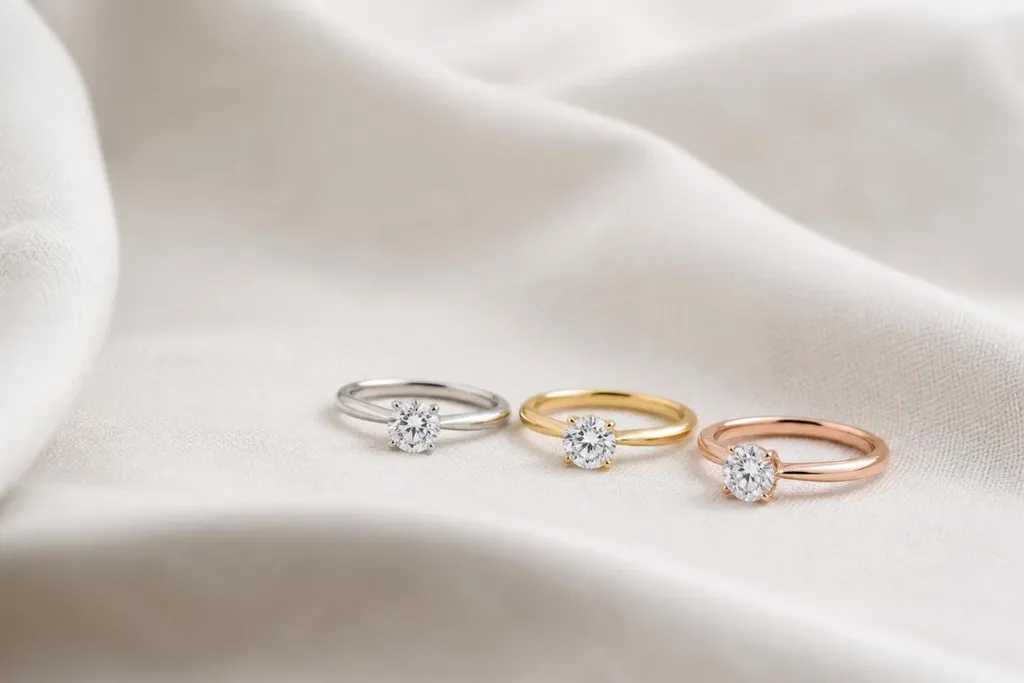
Engagement ring trends change, but certain designs remain relevant because their appeal is rooted in proportion rather than novelty. A well-balanced solitaire, a carefully composed trilogy or a restrained diamond-set band can look equally appropriate years after it was chosen. The details may evolve, yet the underlying design principles remain remarkably consistent.
For couples exploring timeless diamond engagement ring designs, longevity is best considered as a combination of stone shape, setting and personal style. A ring does not need to be plain to feel timeless, nor does it have to follow the most traditional formula. What matters is whether its elements work together naturally and whether the design still makes sense once the influence of current fashion is removed.
The Solitaire Endures for Good Reason
The solitaire remains one of the clearest examples of lasting engagement ring design. With a single centre diamond and relatively little surrounding detail, attention falls on shape, proportion and the quality of the setting.
Round brilliant diamonds are an obvious match for this approach because their symmetry and lively light performance have broad appeal. Oval and cushion cuts offer softer alternatives, while emerald and Asscher cuts bring a more architectural character without making the ring unnecessarily elaborate.
A solitaire also allows small design choices to matter. A fine band can make the centre stone appear more prominent through contrast, while a slightly broader band gives a larger diamond greater visual balance.
This explains why someone might prefer a 2-carat centre stone over a 1-carat diamond for reasons beyond size alone. The larger stone may better suit a broader band, longer fingers or a preference for stronger proportions. Equally, a smaller diamond can look beautifully considered when its scale suits the hand.
Trilogy and Shoulder-Set Rings Add Detail Carefully
Timeless does not have to mean minimal. Designs with additional diamonds can remain enduring when the extra detail supports rather than overwhelms the centre stone.
A trilogy ring is a good example. Two side stones create width across the finger and give the design a strong sense of balance. Depending on the shapes selected, the result can feel traditional or distinctly contemporary.
Shoulder-set rings take a different approach. Smaller diamonds along the band create a gradual transition towards the centre stone and introduce additional sparkle without changing its fundamental outline.
Proportion is especially important in both styles. Side stones that are too dominant can compete with the centre diamond, while an excessively wide pavé band may alter the visual balance of a delicate centre stone.
The most enduring designs tend to have a clear hierarchy: the eye understands immediately where the focal point is, with surrounding details providing support.
Classic Diamond Shapes Can Still Feel Individual
Choosing a timeless shape does not mean every engagement ring will look alike.
Round diamonds provide symmetry and traditional brilliance. Oval cuts introduce length while retaining curved edges, making them particularly versatile across solitaire, halo and shoulder-set designs. Cushion diamonds combine softness with substantial presence and can move easily between modern and vintage-inspired settings.
Emerald cuts offer something more restrained. Their long step facets create broad flashes of light and a clean geometric appearance. Radiant and princess cuts provide stronger sparkle within angular outlines, while pear and marquise diamonds bring a more directional silhouette to the finger.
Rather than asking which shape is most fashionable, consider which one resembles the wearer's existing aesthetic. Jewellery that reflects established personal taste is less likely to feel dated simply because trends move elsewhere.
Metal and Practicality Complete the Design
Metal can subtly change the character of an otherwise classic engagement ring.
Platinum and white gold create a cool backdrop that blends naturally with colourless diamonds. Yellow gold introduces warmth and contrast, while rose gold produces a softer interpretation.
Practical construction matters just as much. A very high setting may look dramatic but can catch more easily during everyday activities. Delicate pavé requires sensible care, while claws should be periodically inspected regardless of setting style.
Future wedding-band pairing should also be considered. A beautifully proportioned engagement ring becomes far easier to wear long term when its profile works comfortably with the rest of the bridal set.
Final Thought
The diamond engagement ring styles that endure are not necessarily the simplest or most traditional. They are the designs in which proportion, craftsmanship and personal taste have been given greater importance than temporary fashion.
Whether that means a restrained solitaire, a balanced trilogy or a diamond-set band, the principle remains the same: allow the centre diamond to have a clear role, choose details with purpose and consider how the ring will actually be worn. That is what turns a fashionable purchase into a genuinely timeless piece of jewellery.